
Stephanie Burns, alum and gaming executive, is spring Dialogue with the Dean guest
 Take risks. Lead with creativity. Get to yes.
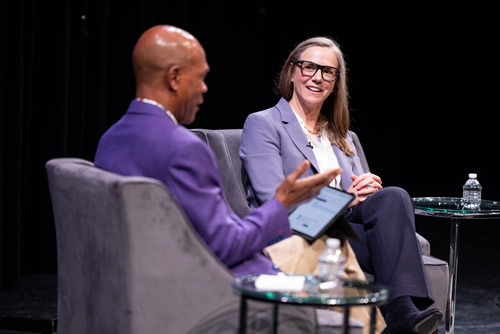
So says Stephanie Burns (C91), the global legal and public policy lead for Sony Interactive Entertainment (SIE) and Dean E. Patrick Johnson’s final guest of the 2025-2026 academic year in his Dialogue with the Dean series. Burns knows of what she speaks: her remarkable insight, work ethic, and command of IP law has led to enviable positions at SIE, Amazon, and StubHub. And it was her time at Northwestern, she told the online and in-person audience on May 28, that got her trajectory started.
“I bleed purple,” she kicked off the interview saying. “I love this school.”
Burns started off at Northwestern as a music student but found herself sneaking into classes in the radio/television/film department—a habit that stopped when she got caught and then decided to transfer into the major.
“I love films, I love television, I love movies,” she said, “and it was really important to me to exercise that creative part of my brain.”
Her interest in the legal profession was piqued while taking law and entertainment classes taught by Rick Morris, now SoC’s director of professional degree programs. The High Tech Law Institute at Santa Clara School of Law followed, and soon after that she was a paralegal at a Silicon Valley law firm working on a case about counterfeit video games. It was a prescient start for someone who would later become senior vice president and general counsel for SIE, one of the world’s most successful and innovative entertainment companies, which includes PlayStation 5, PlayStation Plus, PlayStation Studios, and PlayStation Network.
Burns and Johnson covered the ins and outs of protecting intellectual property, the sustaining business value of evaluation and iteration, the importance of creative thinking, and, of course, where artificial intelligence fits in. Spoiler: it’s been in the gaming industry for a long time, but Burns contends “AI will never replace human creativity; it just can’t.”
The conversation in the Wirtz Center’s Clara, Lu ‘n’ Em Theater capped a day of visits Burns made to faculty and students, many of whom are involved in the School’s Game Design, Media Arts, and Animation minor. Burns explained that the process of creating a new game is similar to that of linear media, in that storyboarding, screenwriting, acting, and post-production are all involved—only it can take considerably longer and involve even more human creators.
“There will always be plenty of jobs,” she said. “Trust me on that.”
To learn more about Stephanie Burns and hear her conversation with Dean Johnson, watch the video below.